Want a reading made about your situation?
You send the situation. We draw for it and publish the reading as a video on the channel — yours to watch, and to send to whoever needs it. $49.00.
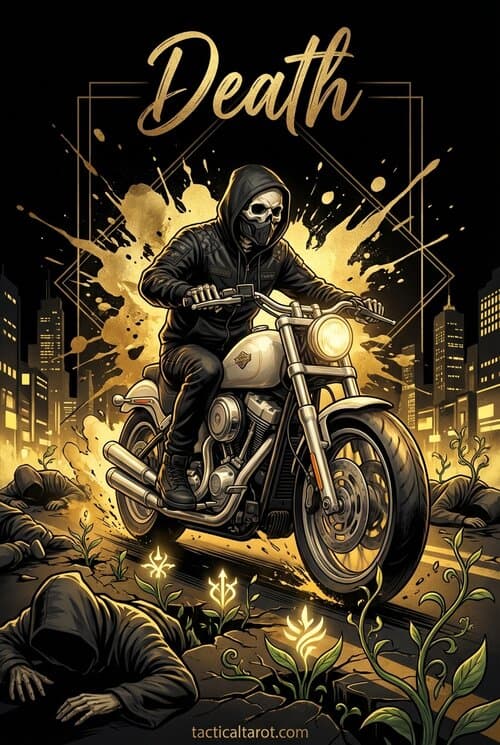
Death Tarot Card Meaning
Death in tarot represents transformation, endings, and necessary change. Learn what this Major Arcana card means when it appears in your reading.
See how Death interacts with your situation.
Death is perhaps the most misunderstood card in the tarot deck. Its name and imagery create fear, but its meaning is almost never about physical mortality. Understanding what Death actually represents—and doesn't represent—unlocks one of tarot's most powerful cards.
The Core Message
Death represents transformation that requires something to end. Not destruction for its own sake—transformation. The old form must die for the new form to live. This is as true in psychology as it is in nature.
Think of seasons. Winter isn't a failure of summer—it's a necessary phase in an ongoing cycle. The tree loses its leaves not because something went wrong, but because that's how growth happens. What seems like loss from one perspective is actually transition when viewed from a larger frame. Developmental psychology has long recognized that identity evolves through stages, each requiring the death of earlier forms of self.
In practical terms, Death often points to identities, relationships, jobs, beliefs, or life phases that have reached their natural end. Clinging to them doesn't preserve them—nothing can. Clinging just makes the transition more painful when it inevitably comes, which it will. The only question is whether you'll release consciously or be pried loose by circumstances.
In Decision-Making
When Death appears in a reading about a decision, consider several angles.
What's already over? Death often confirms what you already know at some level: something has ended. The question isn't whether to end it—it's already done. The question is whether you'll acknowledge what's already true.
What transformation is needed? The ending isn't the point; it enables something. What can't emerge while the old form persists? What are you blocking by refusing to let go?
What are you grieving? Even necessary endings involve loss. Death gives permission to mourn what's passing while still moving forward. You don't have to pretend you're not sad. You do have to eventually move.
Upright Interpretation
Death upright carries several core meanings.
Necessary endings are central. Something must conclude. Fighting this extends suffering without changing the outcome. The ending isn't optional; only your relationship to it is.
Transformation in progress is often indicated. You're becoming something new. The person you were is giving way to who you're becoming. This is uncomfortable—identity transition always is—but it's also growth.
Clearing for new growth follows naturally. Space is being made. What fills that space depends entirely on how consciously you engage the transition. Passive grief fills it with nostalgia and loss; active engagement fills it with possibility.
Natural cycles are being honored. This ending is part of a larger pattern—beginnings lead to endings lead to beginnings. Death isn't a stopping point in the cycle; it's a turning point that enables continuation.
Reversed Interpretation
Death reversed suggests different dynamics.
Resistance to change is common. You're holding on to something past its natural life. The effort of maintenance costs more than release would—and release will happen eventually regardless. Grief research shows that resistance often extends rather than prevents suffering.
Stagnation results from avoiding endings. Without endings, there's no movement. Life becomes a museum of preserved-but-not-alive things. You're not actually preserving anything; you're embalming it.
Incomplete transformation may be occurring. You've started changing but haven't finished. You're caught in liminal space between what you were and what you're becoming. This suspension can't last indefinitely.
Fear of the unknown often underlies the resistance. The familiar feels safer than the uncertain, even when the familiar no longer serves you or has actively become harmful.
When Death Appears
In career readings, expect role transitions, organizational departures, or the ending of career phases. Death also points to the ending of professional identities as you evolve beyond who you've been professionally.
In relationship readings, Death addresses breakups, yes—but also the ending of relationship phases. Dating becoming commitment. Conflict becoming resolution. Together becoming apart. Apart becoming together-differently. Relationships that endure are relationships that survive multiple deaths of earlier forms.
In personal development contexts, Death signals outgrowing beliefs, leaving behind old versions of yourself, and fundamental identity shifts. Who you think you are dies; who you're becoming emerges.
In practical matters, moving, major life transitions, and closing chapters in concrete visible ways are indicated.
The Skeleton Rides
In the Rider-Waite-Smith imagery, Death rides a horse. The skeleton doesn't stop for anyone—king or peasant, young or old, all are treated equally. This isn't cruelty; it's reality. Transformation comes for everyone. Status provides no exemption.
But notice the background: the sun rises between two towers. After death, dawn. After endings, beginnings. The imagery contains both the loss and what follows loss. The card shows the full cycle, not just the difficult part.
Working With Death
Don't avoid this card or the process it represents. Pretending something isn't ending doesn't keep it alive—it just makes you unavailable for what's emerging. Your attention is trapped in denial rather than available for renewal.
Grieve properly. Even wanted endings involve loss. Allow sadness about what's passing without letting grief become the whole story or an excuse for not moving. Grief honored becomes grief metabolized.
Look for the horizon. What's becoming possible that wasn't before? What space is being cleared? What could grow here if you stopped trying to preserve what's dying?
Trust the cycle. Winter leads to spring. Death leads to rebirth. You've survived transitions before—every developmental stage of your life involved the death of who you were before. You'll survive this one. You've proven that already.
The Gift of Death
Death is the card that ends stagnation. When you're stuck in something that no longer serves you—but comfortable enough not to leave on your own—Death arrives. It says: This is over. Time to move.
This can feel harsh in the moment. It can also be the most liberating thing you hear. The permission to stop pretending, to let go, to make space for what's next. The acknowledgment that you're not failing by ending something—you're honoring its natural conclusion.
Upright Examples
Someone draws Death while considering leaving a long-term job. The card confirms what they've been sensing but reluctant to admit: this chapter is complete. The question isn't whether to go—that's already decided at some deeper level. The question is what comes next, and the card invites attention to that rather than to whether the ending should happen.
Death appears in a relationship reading for someone whose partnership has fundamentally changed. The old relationship—the one they had before the crisis, before the revelation, before the growth—has died. It's not coming back. The question is whether a new form can emerge from the remains, or whether the relationship's time is actually done.
An entrepreneur draws Death about a product line they've been nursing along. The card is permission to end something that was once successful but no longer serves. The resources—time, money, attention—are being claimed by something already dead. Death says: release these resources for new growth. Let what's over be over.
Reversed Examples
Death reversed for someone who keeps revisiting an ended relationship. The breakup happened months ago, but they're still living as though reconciliation is possible. The card highlights how the refusal to accept what's already ended prevents them from moving forward. They're not honoring the relationship by refusing to let go; they're trapped in a ghost.
In a career reading, Death reversed suggests staying too long in a role that's already over in every meaningful sense. They're going through motions without genuine engagement, marking time without building anything. The job ended; they just haven't left yet.
For someone afraid of major change, Death reversed indicates the cost of avoidance. Stagnation isn't neutral—it's actively harmful. What they're afraid of losing is already lost; they just haven't faced it. The card suggests that the fear is preserving pain, not preventing it.
When Death Appears
- →During major life transitions in career, relationship, location, or identity
- →When you sense something is over but haven't fully acknowledged it
- →During periods of transformation and reinvention
- →When clearing space for new opportunities requires releasing old ones
- →When processing grief about endings that were necessary but still painful
See how Death plays out in your situation.
Get Your Personal ReadingFor quick reference, see the Death card overview.